Lately, I read about a family of farmers whose crop had failed. They were hungry,and unable to get food. In desperation, the uneducated father collected some toad eggs and fed them to the whole family in an attempt to stave off hunger. By the time they had arrived at the hospital, which was a few hours later ( the father had to run as there were no roads), one of the children was dead, and the other two passed away within 10 minutes of their arrival due to poisoning.
I also read about a 70-year old lady who had to wait for a month to get to a hospital to treat her jaundice. She had no money for the taxi fare and so waited a month to sell off her chickens to have enough money to pay RM 50 for the transport to the hospital. She had to walk two miles to get to the road to get to the taxi. When she arrived, she was septic and had a gallstone lodged in her common bile duct.
One would normally to read about these situations in a World Vision booklet, or perhaps even Time magazine, highlighting the plight of the people in some far off country like Uganda, or the slums of India, or something like that. And as much as I would like to pretend such is the case, the truth is very much close to home. In fact, it is home.
This is Sabah. East Malaysia. Once one of the most naturally resource rich places in the world, now the poorest amongst the thirteen states of Malaysia.
In the 70s, for those Sabahans who lived in rural areas, poverty was a vicious cycle that seemed to never end. They planted their crops, and as they could not travel to the cities to sell the crops themselves, they sold them to middlemen who paid only a fraction of the true worth of the crops. When they fell sick, they sold away their sources of livelihood and valuables just to get transport to the city, and their condition very often dire by the time they arrived. They were unable to uplift themselves economically and socially because there was barely any education in these areas, and even if there was, the schools were much too far and inaccessible for them to make the trip.
Fast forward forty years, and what has changed?
Well, Sabah's first ever flyover was built a few years ago.
The illegal immigrant population now outnumbers the local population, 1.8 million to 1.5 million. A Sabahan even commented since Philippines might be interested in reclaiming Sabah, if a referendum were held, Sabahans would be dead for sure since there is an overwhelming number of Filipinos in Sabah.
Many of Sabah's educated youngsters have left the state for better job opportunities in Peninsular Malaysia.
Sabah has been stripped bare of natural resources: oil, natural gas, timber etc, yielding massive profits for the country, yet it remains a backwater of Malaysia.
Other than that, except for minor improvements, the socioeconomic situation of Sabah remains stagnant.
The answer is: It has changed- for the worse.
As a Malaysian, I feel ashamed that while we have been prospering over here with over high rise buildings, Twin Towers, shopping malls, mini markets, super markets, hyper markets; our brothers and sisters in East Malaysia still remain very much stuck in poverty. While a half hour blackout in Kuala Lumpur warrants a newspaper feature, Sabahans have to put up with constant blackouts, once a week, at least 72 hours a month.( SESB, the Sabah equivalent of TNB, apparently stands for Sabah Everyday Sure Blackout) While we KL-ites complain of cold water, and how we can't stand not having a hot water bath, many Sabahans still suffer from water rationing and shortages ( For instance, in Sandakan water is only supplied two days a week). While we complain of long bus waits and traffic jams, our compatriots who live in rural areas do not have roads and have to walk for hours before getting to a place where taxis are available.
And while the Malaysian government can donate millions of ringgit to victims of the Sichuan earthquake, and send an immediate response team to Japan, it has failed to channel and precipitate development in Sabah for the past forty years. While the Sarawak chief minister's son has 800 million ringgit worth of assets, a big part of Sarawak and Sabah's people remain entrenched in poverty. While we call ourselves an independent nation, the problems of the poor in Sabah are often solved by non-profit international organisations like Raleigh.
As a Malaysian, I am ashamed of the prejudices that we often hold against Sabahans: asking them questions like "Do they live in trees? Do they stay with Orang Utans?" Mistaking Sabah for Sarawak and clumping them together as Sabah Sarawak? As a Malaysian, I am disgusted that we have so often been ignorant of the situation of our own country, and ignored these pleas for help. As a Malaysian, I am saddened and angry that the Federal Government has heard these pleas and done nothing.
And now, I hope I am doing something by crying out, "Save Sabah!" The Federal Government has time and time again ignored the pleas of Sabah, but as Malaysian citizens, we must not. Throw away your prejudices, visit East Malaysia. Look past the rosy picture of things, and see Sabah's dire situation. Celebrate Malaysia Day for what it is: a promise to Sabah and Sarawak, a contract of partnership. Open up your minds and hearts and call out for justice for our fellow countrymen. If you want to be so proud of Mount Kinabalu, don't forget the people who live under its shadow.
To the BN Sabah representatives, you have never supported the interests of the people. You have enjoyed yourselves in the palaces built from the riches of the people, and forgotten about them. When Lim Kit Siang called for a Royal Commission Inquiry into illegal immigrants in Sabah, you did not support him although you knew he was speaking the truth.
An UMNO politician recently remarked that the Chinese and Indians of Malaysia should know their place, and honour the social contract Tun Tan Cheng Lock and Tun Sambanthan signed. Well BN seems to have conveniently forgotten about the other social contract they signed with the peoples of Sabah and Sarawak, to treat them as equal partners in the federation of Malaysia.
Now, is the time to honour that contract.

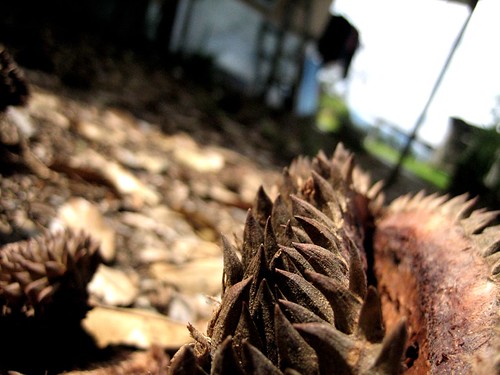
You've heard of a banana republic. Now, welcome to Malaysia's Durian Democracy. The author takes on the thorny ( and occasionally horny) realities of Malaysian politics and its woes; and tries to show that behind that sharp image, Malaysia, still has some succulent, touching, and very genuine goodness in it. Not an easy task indeed, but then again, Malaysia has always been a hard nut ( or durian?) to crack.
Sunday, March 13, 2011
Sunday, February 27, 2011
The Racism Within
| John Malott, former US Ambassador to Malaysia |
Recently, John Malott's article in the Wall Street Journal concerning racism in Malaysia sparked a furore of protests, praises and controversy. Many bloggers have spoken out for and against Malott's views, with a sort of cyber war going on.
This blogger is not going to join that war. In fact, this blogger is not going to deny or support any of the issues discussed in the aforementioned article. I will simply tell you of something that is often ignored.
While the non-Malays are complaining of pro-Malay racism; and Malays are accusing non-Malays of sacrilege and religious desecration, we forget that we are all guilty of racism. We forget that while we have one index finger pointing at one another, we have the other fingers pointing at ourselves.
Where does this racism start? From our upbringing. From a very young age, our parents tell us what Malaysia is. They tell us their views of the world, and being young and malleable, we follow and listen and take it all in. We are told that the Chinese are mata duit, greedy, cheating liars; that the Malays are lazy and use the government as a tongkat; that the Indians are keling, pariah, and dirty- and being so believing of our parents, we accept these views unquestioningly. And when we have children of our own, we unwittingly create this culture of racism, a vicious cycle going on and on and on.
As a child, I had a fear of the dark. I feared the darkness because I could not see what monsters were lurking in the shadows, because I did not know what horrors awaited me. I feared, and thus hated, because I did not understand. And this is what is happening today. We are kept in the dark about each other. As our society moves to segregate, categorize, label, and divide people according to race, we are interacting with each other less, talking with each other less, eating together less. We are understanding each other less, and therefore since we cannot comprehend each other, we fear and hate each other. We are falling under the ease of stereotyping and generalizing.
And that is the sin we are all guilty of. Just as a ping pong ball must be returned to the hitter for the game to continue, the game of racism can only continue if both sides return volleys and hits. Some may argue that we have no choice because racism is used against us, therefore we must respond in kind. Nation A fires on Nation B, therefore Nation B must fire on Nation A. The result? More fire, more lives lost. Being racist to the those who practice racism is not going to make them less racist. In fact, it will only give them more reason to be racist, and we will be stooping down to their level. Racism only leads to more racism. As Mohandas K. Gandhi once said, 'An eye for an eye makes the whole world blind.'
Instead of outright complaining against each other, we should all reflect upon ourselves and ask if we are guilty of racist thoughts as well. Parents should stop this culture of race generalisation, and all races should interact with each other sincerely and thoughtfully, so that we can understand one another. Separating young students according to race in schools, as one educator wanted to after racial fights sprung up in schools, is just going to fuel misunderstanding of one another. We should not be separated- laundry is the only thing that should be separated by color. So the next time you look at someone, try not to think of their race first. And when we can reach that stage of looking at each other, and we recognize each other as members of the nation, and then, and only then, as members of our race, it is then that our nation can truly be 1Malaysia.
Let me begin this process of inflection by admitting that I have been guilty of racism.
Years ago, I embarked on my first bus journey home. It was an alien environment for me; I had always had the privilege of having my parents fetch me home, and the run-down, dusty bus made me feel like Alice in Wonderland, lost and lonely. The other students spoke in rough tones, their speech littered with Cantonese expletives from time to time. They were of all ages, and all of them were Chinese, with the exception of one boy. This Indian boy was the subject of constant ridicule, bullying, and mockery, but he just took it all in, always a blank stare boring into the greasy metal floor. Words like ‘keling’ flew around, carelessly and callously. Being from a family that always taught me all humans were equal, and having friends of other races myself, I was shocked and shamed by their conduct. But I did nothing, being afraid and alone. And by doing nothing, I had effectively condoned and allowed such a blatant act of racism continue, I had become an accomplice. By my silence, I had contributed to the chaos that ensued.
I often think back to that moment and wish I had done something. But I cannot change the past, and so I am now trying to change the present, for a better future. Racism may be institutionalized in Malaysia, but racism is also internalized in all of us. Fight racism inside yourself, then carry that fight to the world.
"Be the change you want to see in the world."
- Mahatma Gandhi
Labels:
change,
john malott,
keling,
malaysia,
nep,
pariah,
racism,
wall street journal
Wednesday, February 23, 2011
Durian Dilemma
Now I have received some complaints that my blog doesn't live up to its name. Although I say Malaysia, is like a durian , I only show the thorny side of Malaysia, and I never show the succulent goodness that hides within. Well, alright, to satisfy your cravings, here is an account of the goodness I witnessed while I was on the commute in the good ol' LRT.
So here I was, standing at the Pasar Seni station, looking down. Over the horizon there is Masjid Jamek, and the whir of cars zooming past on the road. The buses and their attendants shouting out. A beggar down at the elevator ( he is always there), who is an old man with a polystyrene cup, hands outstretched to plead with the next person who passes the elevator. Does this sound a bit depressing? There was a graffiti drawing of the RTM logo and a somewhat distorted Mahathir at the power station below. Ok, definitely depressing.
ANYWAY... So there I was at the Pasar Seni station, when the train came. Everybody stood up, and rushed towards the entrance. People who drive all the time complain about the yellow box, at least they will never have to feel the terror of being pushed past the yellow line by rushing commuters just as the train is hurtling towards you. Today, I staying far behind the flood of passengers to avoid Bernoulli's Principle in action ( ya know, fast velocity train, creates low pressure. you get sucked in= Final Destination?). AND I found something that shocked me. THEY WERE LINING UP. $#@~*!!!! At long last, after years of complaining, there they were, commuters at rush hour, lining up in an orderly, civilized manner. Then I heard one of the group speak.He spoke Chinese, but in an accent that made it sound more like what you would get if mom and dad were having a pots and pans fight. Mainland Chinese.
As I filed in, and took my usual place to stand ( the head/ tail of the train where you can have a front view). I was pretty upset, my hopes being dashed by a bunch of PRCs. I noticed there was a man, this elderly Malay chap with songkok and his tongkat, holding on for dear life to the metal pole as the train accelerated. He seemed rather frail. There were lots of young people who were sitting around him. I saw one young student ( he was in school uniform) glance at the old man, then at his tongkat, and when the man caught him looking, the student stood up..... then adjusted his shirt and sat back down. Terrible.
When I turned back, the old man was sitting across the student. Someone had given up their seat! Joy! A kind samaritan at last! I looked at him, and he was speaking to these two young men. His eyes said it all: Thank you. Curious to see what they looked like, I tilted my body left ( very nearly lost balance as the train turned) and saw their faces. They had rather dark skin, though did not look to be Indian or Malay. And once again, they opened their mouths and destroyed me. They were BURMESE!
At this point, I was wishing that somehow at the precise moment these Chinese tourists and Burmese workers chose to open their mouths I would suddenly be struck with some form of rare epilepsy triggered by the onset of contact with foreigners, so that I could keep telling myself Malaysians are such kind, orderly, civilized people. Yes, I know there are kind Malaysians, I know quite a few of them myself. But why does the majority behave like this? The pushing, the refusal to give the man a seat even after ten minutes of seeing him stand and suffer? And in the end, it is the foreigners who behave better in our own country, and treat the poor fellow better. It is them, the Burmese who come from such impoverished backgrounds, who have the heart to give.
So there you have it, the succulent goodness in Malaysia. Except that it's in Malaysia, but not from Malaysia. Ah well. Imported Burmese durian anyone?
ANYWAY... So there I was at the Pasar Seni station, when the train came. Everybody stood up, and rushed towards the entrance. People who drive all the time complain about the yellow box, at least they will never have to feel the terror of being pushed past the yellow line by rushing commuters just as the train is hurtling towards you. Today, I staying far behind the flood of passengers to avoid Bernoulli's Principle in action ( ya know, fast velocity train, creates low pressure. you get sucked in= Final Destination?). AND I found something that shocked me. THEY WERE LINING UP. $#@~*!!!! At long last, after years of complaining, there they were, commuters at rush hour, lining up in an orderly, civilized manner. Then I heard one of the group speak.He spoke Chinese, but in an accent that made it sound more like what you would get if mom and dad were having a pots and pans fight. Mainland Chinese.
As I filed in, and took my usual place to stand ( the head/ tail of the train where you can have a front view). I was pretty upset, my hopes being dashed by a bunch of PRCs. I noticed there was a man, this elderly Malay chap with songkok and his tongkat, holding on for dear life to the metal pole as the train accelerated. He seemed rather frail. There were lots of young people who were sitting around him. I saw one young student ( he was in school uniform) glance at the old man, then at his tongkat, and when the man caught him looking, the student stood up..... then adjusted his shirt and sat back down. Terrible.
When I turned back, the old man was sitting across the student. Someone had given up their seat! Joy! A kind samaritan at last! I looked at him, and he was speaking to these two young men. His eyes said it all: Thank you. Curious to see what they looked like, I tilted my body left ( very nearly lost balance as the train turned) and saw their faces. They had rather dark skin, though did not look to be Indian or Malay. And once again, they opened their mouths and destroyed me. They were BURMESE!
At this point, I was wishing that somehow at the precise moment these Chinese tourists and Burmese workers chose to open their mouths I would suddenly be struck with some form of rare epilepsy triggered by the onset of contact with foreigners, so that I could keep telling myself Malaysians are such kind, orderly, civilized people. Yes, I know there are kind Malaysians, I know quite a few of them myself. But why does the majority behave like this? The pushing, the refusal to give the man a seat even after ten minutes of seeing him stand and suffer? And in the end, it is the foreigners who behave better in our own country, and treat the poor fellow better. It is them, the Burmese who come from such impoverished backgrounds, who have the heart to give.
So there you have it, the succulent goodness in Malaysia. Except that it's in Malaysia, but not from Malaysia. Ah well. Imported Burmese durian anyone?
Monday, February 14, 2011
The Tragedy Of Valentine- History Repeats Itself
More than two millennia after the persecution of Christians under the Roman pagans, and the execution of St. Valentine, a new form of oppression has returned to haunt us. The perpetrators this time are not Roman centurions, but rather the National Fatwa Council, elements of PAS, as well as the Deputy Prime Minister himself.
Because I believe in rights. I believe that all of us, have the right to freedom of speech, freedom of movement, freedom of action as enshrined in the Constitution. Every one should have the right to celebrate a day of significance. A day which, though it is affiliated with a Christian priest, has evolved throughout the ages to become something else. To prove my point, let me divulge into the origins of Valentines Day. It is said that Valentine was a priest in the Roman ages. At the time, Emperor Claudius disallowed men from marrying as he needed them ready to be drafted as soldiers. The soldiers who defied this order, and wanted to marry, went to Valentine, who as a priest, presided over their marriages. When the Emperor found out, Valentine was executed. The date: February 14. This is the generally accepted story regarding the origins of Valentines Day. Therefore, by looking at the date, it is in fact a day of mourning for a noble man, who stood up for people's rights. A man, who recognized that everyone should have the right to marry, to choose their companion for life, and died a martyr's death for that cause. So in actual fact, Valentines Day does not celebrate Christianity. It celebrates human rights!
I suppose we are not the only country in the global headlines for banning Valentines Day. At least we have Iran ( yes, nuclear bomb building, extremist, US and UN defying Iran). Not exactly the best of countries to be compared with. Iran too, has spoken against Valentine's Day, the official reason being that it was getting too popular, therefore it had to be stopped. No wonder no political opponents can surface in Iran, they must have been stopped for the exact same reason. Hmph. I, for one, can wholehearted say, that I am firmly against the ban.
Now, before a flurry of assaults will condemn me as a Hallmark holiday activist, Christian evangelist, anti-PAS or anti-BN, or whatever label they wish to throw at me, allow me to explain. Firstly, I am not a particular fan of them, all the mushy gooey stuff, and flowers going round at ridiculously inflated prices. Secondly, I am not Christian. Thirdly, I have great respect for those PAS members whom are well educated, firm in their principles, and stand up for them. I cannot say the same for the latter. So you may wonder, why on earth am I kicking up a fuss about Valentine's Day since it does not really concern me?
Now look at it from another angle. Some may argue that it has somewhat Christian origins, because it was inspired by a priest, therefore it is 'haram'. However, one only needs to look into its history to see that it was never celebrated as a religious festival. Also, if Valentines Day should be banned, so one might as well ban Father's Day and Mother's Day, with the former first conceived by a Christian lady, and the latter originating as a Greek pagan festival. My point is this: the only constant in this world is change. Sunday used to be a holy day for pagans honoring the Sun God, now it is a day of worship for Christian; the Kaabaa was once used by the Quraisy to worship pagan deities, now it is a holy place for followers of Islam. Valentines Day may have once upon a time had connections to religion, but no more. It is now simply a day where people appreciate each other, and find time to express their affection for each other. Is not showing love, and loving others encouraged amongst all races, all religions?
Another argument that has surfaced amongst supporters of this move to ban Valentines Day ( and crack down on couples) is that Valentines Day encourages immoral activities and I quote from Wan Mohamad Sheikh Abdul Aziz, "In reality, as well as historically, the celebration of Valentine's Day is synonymous with vice activities". Rrrrrrright. So by vice activities I must assume he means consuming alcohol, gambling, not wearing panties, and khalwat. Firstly, I would like to challenge him to present his evidence to his statement. As far as I know, in reality, as well as historically, Valentines Day has always been a day to celebrate love, by exchanging gifts and what not. Hmm. Secondly, I must point out to him that Valentines Day, in no way, encourages vice. Think about it, if a person is morally right and a religious man, would he succumb to the "dark influence" of Valentines Day and fall into vice? And if a person is the type that would be inclined to commit vice on Valentines Day, wouldn't he do it every other day? Do you think a person who commits khalwat on Valentines Day does so because of Valentines Day? Think about it logically and rationally. By issuing such a statement, he is projecting an image that Muslims are so very easily influenced, and so very easily tempted and swayed, which cannot be further from the truth. If one is strong willed, he will never sway; if one is weak willed, he will always grab the first opportunity that comes along and blame it on something else.
As such, I urge the BN and PAS government to reconsider their move. Politically, rationally, socially, and in some ways even religiously, it is a mistake, and only serves to heighten racial tensions and throw Malaysia into the very very very sour 'lime' light once again. And to those who can see the bigger picture, Happy Valentines Day to you.
Thursday, February 10, 2011
Egypt- Of Mummies and Mubarak
On the 2nd of February 2011, the great men and women of Egypt made history. Almost two million gathered in the heart of the city of Cairo, in Tahrir Square. It was a call for democracy, a call for equality, a call for liberty. A call for the very fundamental human rights to be restored to the people of Egypt.
As I sat, enraptured by the chain of events, I could not help but feel fantastic. I felt empowered. I felt moved. The sheer solidarity of the people, and the unimaginable scale of protests, sent shock waves throughout the region and throughout the hearts and minds of people. And I stayed glued to Al-Jazeera for the days that followed, more and more convinced that change was soon to come.
And on the eve of elections in Malaysia, I hope that change will come to our shores as well. Our prime minister said there were lessons to be learned from Egypt. Well, he is perfectly right. There are deep and invaluable lessons to be learned, traditions to be thrown away, and mindsets to be abolished.
Number One.
We can exact change.
Look at Egypt today. A month ago, they cowered under the might of the state apparatus, resigned in their fate. They were angry, indignant, but tired. No longer. They have risen up, the great people of Egypt, Muslims and Christians and Jews, for progress. They have begun a process that can never be undone. They have risen, not bolstered by American troops or UN sanctions, but empowered and emboldened by their wills. There's a saying that great men shape the annals of history. And in Egypt, a great people can shape the course of their country. And so can we. Throw away that apathy, that 'Tak Apa', that resigned defeat. Believe in ourselves. And do something about it. Choose the better and empower our future, because as P. Ramakrishnan, president of Aliran put it, 'by our silence, we contribute to the chaos that ensues'.
Number Two.
Society will not collapse because of a collapse in a particular government. We have long heard claims saying that "the 'other side' has no experience." "We are the best because we are the most experienced." "If we are not elected there will be chaos." "Do not let the ghosts of May 13 return."
Utter propaganda, uttered by a desperate government, in a foolish attempt to blind the uninitiated. The people will provide, and ordinary men and women rise up to the occasion in spite of the chaos. In Egypt, in the face of no internet and mobile networks, people have come up with ingenious ways of communication, such as the relay system. Ordinary citizens have taken it upon themselves to direct traffic, provide food, drink and shelter, despite no galvanizing leadership. And when looters threatened the artifacts of Cairo Museum, the people banded together and formed a human wall to protect their heritage. Such incidents have only strengthened my belief that there are good souls who can become great individuals, normal and quaint people that become stronger and braver when the need is great. And as Malaysians, should believe in the worth of the individual, and of giving those who have been deemed as "too inexperienced", "too young" a chance. We should believe, and have faith in Malaysia, that we can weather anything the cronies, the corrupt and the crooks throw at us, and emerge a greater nation.
Number Three.
There is no such thing as an unchangeable situation.
Mubarak has been in power for more than 30 years now. People believed it would never change. That his party would always be almighty, that the police would continue brutalizing them, that true democracy was but a fragile and far off dream. But now, all that is going to change. Now, Mubarak might as well be a mummy, with Egyptians more than eager to bury his evils, and move forward. We can change too. All it takes is for us to do something, anything. Because there is always hope.
And so tonight, as I close my eyes, I pray. To the noble citizens of Egypt, I pray. And to Malaysia, a country where the ISA still reigns supreme, a country where police brutality is still rampant and cronies and corruption are still the order of the day- I pray.
And God willing, I'm hoping my prayers will be answered.
As I sat, enraptured by the chain of events, I could not help but feel fantastic. I felt empowered. I felt moved. The sheer solidarity of the people, and the unimaginable scale of protests, sent shock waves throughout the region and throughout the hearts and minds of people. And I stayed glued to Al-Jazeera for the days that followed, more and more convinced that change was soon to come.
And on the eve of elections in Malaysia, I hope that change will come to our shores as well. Our prime minister said there were lessons to be learned from Egypt. Well, he is perfectly right. There are deep and invaluable lessons to be learned, traditions to be thrown away, and mindsets to be abolished.
Number One.
We can exact change.
Look at Egypt today. A month ago, they cowered under the might of the state apparatus, resigned in their fate. They were angry, indignant, but tired. No longer. They have risen up, the great people of Egypt, Muslims and Christians and Jews, for progress. They have begun a process that can never be undone. They have risen, not bolstered by American troops or UN sanctions, but empowered and emboldened by their wills. There's a saying that great men shape the annals of history. And in Egypt, a great people can shape the course of their country. And so can we. Throw away that apathy, that 'Tak Apa', that resigned defeat. Believe in ourselves. And do something about it. Choose the better and empower our future, because as P. Ramakrishnan, president of Aliran put it, 'by our silence, we contribute to the chaos that ensues'.
Number Two.
Society will not collapse because of a collapse in a particular government. We have long heard claims saying that "the 'other side' has no experience." "We are the best because we are the most experienced." "If we are not elected there will be chaos." "Do not let the ghosts of May 13 return."
Utter propaganda, uttered by a desperate government, in a foolish attempt to blind the uninitiated. The people will provide, and ordinary men and women rise up to the occasion in spite of the chaos. In Egypt, in the face of no internet and mobile networks, people have come up with ingenious ways of communication, such as the relay system. Ordinary citizens have taken it upon themselves to direct traffic, provide food, drink and shelter, despite no galvanizing leadership. And when looters threatened the artifacts of Cairo Museum, the people banded together and formed a human wall to protect their heritage. Such incidents have only strengthened my belief that there are good souls who can become great individuals, normal and quaint people that become stronger and braver when the need is great. And as Malaysians, should believe in the worth of the individual, and of giving those who have been deemed as "too inexperienced", "too young" a chance. We should believe, and have faith in Malaysia, that we can weather anything the cronies, the corrupt and the crooks throw at us, and emerge a greater nation.
Number Three.
There is no such thing as an unchangeable situation.
Mubarak has been in power for more than 30 years now. People believed it would never change. That his party would always be almighty, that the police would continue brutalizing them, that true democracy was but a fragile and far off dream. But now, all that is going to change. Now, Mubarak might as well be a mummy, with Egyptians more than eager to bury his evils, and move forward. We can change too. All it takes is for us to do something, anything. Because there is always hope.
And so tonight, as I close my eyes, I pray. To the noble citizens of Egypt, I pray. And to Malaysia, a country where the ISA still reigns supreme, a country where police brutality is still rampant and cronies and corruption are still the order of the day- I pray.
And God willing, I'm hoping my prayers will be answered.
Saturday, January 22, 2011
Interlocked In Interlok
Keepers of knowledge, the papers were torn, and ravaged; thrown and spit on; burnt to a crisp until the pages were no more. They were deemed seditious, malicious, ideologically and politically incorrect, and thus they had to be destroyed as an act of defiance.
This was not Shi Huangdi, burning books so no scholars would become more intelligent than him.
This was not Adolf Hitler, monarch of the Third Reich, burning all books that were deemed un-German.
Neither was this the Communist Party, burning all texts written by "capitalist pigs".
This was Malaysia, nine years from 2020, and these were books burnt by angry citizens.
The book? Interlok.
Interlok, a book written by Abdullah Hussain, has recently come under fire for its "racist" and "discriminatory" content, with characters in the story calling another Indian character a "pariah" and a "keling". Politicians from the opposition have been quick to capitalize on this, stoking the flames of discontent, using it to fire up unrest, instead of steering the rakyat to a more progressive, and practical way of solving this. Instead, community leaders have shown themselves to be of the same political genius of the likes of Adolf Hitler and Shi Huangdi.
Firstly, as a fellow Malaysian, I can understand their rage, but what I cannot, and never will condone is their manner of handling the issue at hand. Burning books? Barbarians, Nazis, Communists and terrorists burn books, not civilized, educated people! By committing this atrocity, these angry citizens have not only further stoked racial unrest, they have also destroyed the sanctity of books. They have only further validated, and proven that Malaysia is far from an open minded, tolerant society.
When someone disagrees with you, one does not kill the person, or shut them up with duct tape. One endeavors with logic and reason, to debunk their arguments, to prove that they are wrong. It is the most effective, most practical way of handling an issue like this. If one is unhappy, one should complain to the press, go through the legitimate procedures, and tell the world about it. Burning and other acts of destruction only paint a radical, extremist light on the activists, however noble their intentions may be.
Secondly, I am of the opinion that Abdullah Hussain's novel is exactly what it is meant to be, a NOVEL. It is a story meant to entertain, educate, and raise awareness. The whole reason of the writing about the ill treatment given to the Indian character, is to raise awareness about it, so that readers know that it is wrong. The caste system, keling, pariah, these things have in fact happened in the past. In some ways, these things still remain at large in society. Some say it is unreasonable to comment on the caste system. However, the caste system, though officially abolished, still survives in a form, because in India there is still prejudice against the untouchables, and there is still a great divide between the rich and the poor.The racial injustices mentioned in the book are still happening today. The problem is, that people take literature too literally. The caste system is a symbol of the injustice that happens all over the world simply because of one's background; the racial injustices are reflective of the very things we must avoid. So what if things are not 100% factually correct? Nobody said Interlok was a factual historical commentary, in fact, Interlok is a work of FICTION.
At the very same time, the incidences in Interlok do not glorify and condone the acts of racial discrimination mentioned. They simply reflect what society was at the time. Mark Twain's Huckleberry Finn, has characters calling African Americans 'negroes'. These characters act the way they do simply because that was how things were in that era. Khaled Hoesseni's Kite Runner describes a child being sodomised. Does writing about it indicate that the author condones it? No! It is in fact, the opposite; the author wishes to fight it, and instead of ignoring the problem, chooses to acknowledge it, and tackle it head on. In George Orwell's 1984, he describes an authoritarian society, with a Big Brother watching over all. Had he been published in Malaysia, his book probably would have been burnt, as a text that spreads communist ideals. This could not be further from the truth, he is in fact fighting the evils of communism by raising awareness about it, by shocking the reader, so that the reader can understand how terrible communism can be. Likewise, Abdullah Hussain fights racism, by showing us how things should NOT be.
In essence, Interlok retains its integrity as a piece of literary fiction. On the other hand, its validity as a textbook is not as sound. Not because of its content, but because of the teachers teaching the subject matter. The teachers using Interlok as studying material must be able to handle the racial issues raised in the book maturely and reasonably. Students must be educated so that they know the characters' ill treatment of Indians is wrong, and of the social context of the novel. And so, the real question is not whether Interlok is a good textbook, but rather, can our Malaysian teachers handle it sensitively and responsibly? With no offence meant to those truly Malaysian educators, it might be wise to point out all the controversy surrounding the principal who asked racial minorities to go back to China and India. With such educators in charge of schools, how can we expect students to emerge with progressive, tolerant mindsets?
The Education Ministry has been placed between a rock and a hard place. If they choose to withdraw, they will be acceding to the demands of political and narrow minded bickering, as well as damning Abdullah Hussain's work of literature. Should they choose to do otherwise and retain the book, they might be causing untold damage at the hands of some racist and equally narrow minded educators. Once again, it seems like the Malaysian government has got itself INTERLOCKED in a bad situation. Surprise, surprise.
Tuesday, January 4, 2011
Why?
A while back, I met my friend's father, who is a staunch MCA supporter. Upon finding out I was interested in politics, he asked me whether I supported DAP or MCA. I told him that I would support whoever served the rakyat's interests. He gave me an incredulous look, laughed, and said it was utter bullshit.
So this is what it has come to. Our politicians have used the term "For the rakyat" this, "For the rakyat that" to the point it has become a byword for nonsense, and the calling of politics known as craptology. It saddens me when I hear these comments, because it reminds me of the sad state of affairs our Malaysian politics is in. Our politicians, from being called champions of the people, are now in the eyes of people bloodsucking leeches, liars, rapists, cheaters, fraudsters, crooks, thieves and worst still, assassins or C4 bombers.
People chide me for being saddened. They say I should get used to things, that I should be less idealistic, less optimistic, care less. And I thought to myself sometimes, "It's true. What can we do against such reckless bigotry? Such blatant crime? Better to resign one self to one's fate, and be satisfied with what we have. At least we're not as bad as the Philippines where in Maguindanao they butcher people, or like Iraq where bombers ( not just the mongol-philia type) are aplenty. That's why I should give up.
I tried. But I cannot.
The moment we stop caring, the instant we stop striving to become better, we die. Not outside, but inside. The second we give up, that is when everything is truly lost. Edmund Burke once said that all that is necessary for the triumph of evil is for good men to do nothing. And dammit it's true.That's why we must not give up.
We as the people of Malaysia cannot give up. We cannot simply migrate and pretend, and forget our country. A fool, an idiot and a bloody deluded man I may be, but a faithful and honest fool I remain. I know I am doing this for the people. People who have suffered much in the prisons under the ISA are certainly doing it for the people. It's simply not worth it for money, fame or power. It's a reason, a calling greater than individual needs or wants, a desire to serve that overcomes the seduction of being served. That is why I am doing this.
Care more. Do more. And be the change you wish to see in the world. Because we should. Because we must. Because we can. Because we are Malaysians. And that, is why.
Subscribe to:
Posts (Atom)